Edge of the World Riyadh ToursAn Independent Guide Check Availability

Edge of the World Riyadh Tours

Ninety kilometres of highway and dirt track separate the city from a limestone rim that falls away to an empty plain. The Edge of the World Riyadh tours compared here all solve the same problem — the drive — then differ on how long they leave you standing up there.

Updated August 2026

  • Rated 4.6 to 4.9 on GetYourGuide
  • Free cancellation up to 24 hours
  • Prices read from the listings in August 2026

Quick answer

We currently compare six guided trips sold from Riyadh. Five go to the cliff itself and one goes somewhere else entirely. The two cheapest, at $40, are the sunset run with the most feedback behind it and the highest-rated small group, which also gives you the longest stretch on the rim. Above them sit a guided picnic trip, a two-hour hike with a hotel-pickup option and the dinner-and-bat-cave day. There is no entrance fee at the site — you are paying for the vehicle, the driver who knows the track, and whatever the operator adds around the view.

Key takeaways

  • The site itself is free; the tour price buys the 4x4 and the driver. What the money actually covers
  • Time on the rim ranges from 90 minutes to four hours, and that gap decides the day more than price does. Side by side
  • Most operators meet you at a café or metro station, not your hotel — only one listing includes door-to-door pickup as standard
  • October to March is the usable season; from May the clifftop passes 40 °C with no shade. Month by month
  • Sunset trips outnumber sunrise ones for a reason to do with which way the cliff faces. Which departure to book

Edge of the World Tours from Riyadh

All six run from Riyadh with a guide and a 4x4, and all are sold through GetYourGuide, which handles booking, payment, changes and cancellation. Prices, ratings and review counts below were read from the listings in August 2026 and move with demand and currency. The fourth listing carries the Edge of the World name in its URL but runs to the Red Sand Dunes on the other side of the city; it is kept here, labelled, so you can tell the two trips apart.

Independent tour comparison
Listings last read: August 2026
Site facts checked against Saudi tourism sources
Traveller feedback reviewed: 3,100+ reviews

Which Trip Leaves You Longest on the Cliff

Read the third column first. Ninety minutes covers one viewpoint, some photographs and the sunset. Two and a half hours lets you walk out along the rim to where nobody else has bothered to go.

Tour From Time on the cliff Book Total day What else is in it Rating
Camels & stargazing 4x4 $40 1.5 hours Details 6 to 7 hours Camel farm, gazelle park, snacks, optional dinner 4.7 (1,154)
Sunset small group $40 2.5 hours Details 6.5 hours Gazelle reserve, Arabic coffee, stargazing 4.9 (900)
Gazelle sanctuary 4WD $53 1.5 hours Details 6 hours Sanctuary stop, sunset picnic, licensed guide 4.8 (247)
Guided hike $70 2 hours Details 6 to 7 hours Hotel pickup option, two-hour guided hike 4.6 (476)
Bat cave & dinner $60 4 hours Details 7 to 8 hours Camel ride, bat cave, heritage dinner included 4.6 (292)
Red Sand Dunes safari $156 Does not go there Details 4 hours Quad bikes, sandboarding, hotel pickup 4.8 (31)

Six listings, six different operators. Unlike most attractions where two or three companies resell the same seats, these are separate outfits with their own vehicles, guides and meeting points, which is why the review scores diverge as much as they do.

Live Availability and Prices

Dates and live pricing for the highest-rated of the six, straight from the booking platform. The prices printed on this page were last read from the listings in August 2026.

Powered by GetYourGuide

How to Choose Between the Edge of the World Tours

The cliff is the same for everyone. What you are choosing is how long you get, who is driving, and what fills the four hours of the day that are not the view.

You want the view and nothing padded around it

Book the $40 small-group sunset trip. It carries the highest rating of the six at 4.9 from 900 reviews, and its subscores are unusual: guide, transport and value for money all sit at 4.9, so nothing on it is quietly dragging the average down. It also gives you two and a half hours on the escarpment against the ninety minutes most listings allow, with photo stops built into the route rather than granted if the schedule holds.

The trade-off is the start. You meet the guide in a café inside a fuel station on Olaya Street in central Riyadh — he wears an operator cap so you can find him — rather than being collected from your hotel. If you are staying in the Olaya or Al Malaz districts that is a short taxi ride. If you are out near the airport hotels, add half an hour and a fare to the real cost.

Arabic coffee, Saudi tea and water are served in the desert, and the group stays out for stargazing after the sun goes. There is no dinner, so eat before you leave or book a table for after 22:00.

You want dinner, and you want the day to be an event

The bat cave and dinner trip is the longest itinerary here and the only one where a sit-down meal is inside the price rather than an add-on. The published running order is a camel ride of seven to ten minutes, four hours around the Edge of the World, an hour at the cave, then roughly two hours at a desert istiraha — a traditional walled rest house — for dinner with heritage activities.

Four hours on the cliff is more than double what the sunset runs give you, and it changes what the place is. Ninety minutes is a viewpoint. Four hours is a walk out along the rim to the sections where the escarpment turns and the plain opens on two sides.

The operator asks you to bring a flashlight, which tells you what to expect of the cave: it is a real scramble in the dark, not a lit walkway. The platform's own review summary for this listing praises the guides and the views while noting that some travellers wanted more comfortable vehicles and more dependable air conditioning. At 4.6 from 292 reviews with transport scored lowest at 4.4, that criticism is consistent enough to plan around: it is a long day in a vehicle that reviewers rate as the weakest part of it.

You are being collected from your hotel, or the day does not happen

Only the Red Sand Dunes safari includes door-to-door hotel pickup as standard, and that trip does not go to the Edge of the World at all. Among the cliff tours, the guided hike is the one that sells hotel pickup as a bookable option — you choose it at checkout and pay the difference. Everything else expects you at a fixed meeting point: a metro station car park, a café at Tijan Plaza, a Starbucks at Saad Square, or the Olaya Street fuel station.

That listing also gives you two full hours on the cliff. Its weak spot shows in the review summary, where travellers ask for clearer commentary and say it can feel like transport with a driver rather than a guided trip. If you want somebody explaining the geology on the way out, this is not the one. If you want a comfortable vehicle, a long stretch on the rim and a pickup outside your hotel, it is.

You are travelling with someone who will not manage two hours on rough rock

Take the gazelle sanctuary 4WD trip. It is the most curated of the group: a licensed local guide, a modern off-road vehicle, ten minutes at the Arabian gazelle sanctuary, a short hike across several clifftop peaks and a sunset picnic of Saudi sweets, dates and Arabic coffee. Ninety minutes on the rim is enough for sunset without committing anyone to a long walk.

Read the restrictions before you book. The operator does not sell it to pregnant travellers or to anyone with back problems, and the reason is the off-road section rather than the walking — the last stretch of track shakes the vehicle hard. Reviewers scored the guide at 4.8 and mentioned crowded SUVs and uncomfortable back-row seats often enough that the operator now suggests rotating seats. Ask for a front row if the drive is the problem.

You want the cheapest seat and you do not mind a bigger machine

The camels and stargazing run has 1,154 reviews, more than twice any other listing here, and it costs $40. Departure is a fixed 15:30 from a metro station car park; the route stops at a camel farm and a gazelle park before two hours of driving deliver you to the rim for a ninety-minute guided walk and sunset, with the vehicle back around 20:30 at King Salman Oasis metro station.

Snacks and water are included. Dinner is not — it is offered as a paid extra quoted at €35 on the listing, so if you want the desert-camp meal, the $40 headline becomes roughly $80. Reviewers say the guides are friendly and good with a camera, and that the communication about pickup timing could be clearer. Message the operator through the platform the day before and confirm where the vehicle actually stops.

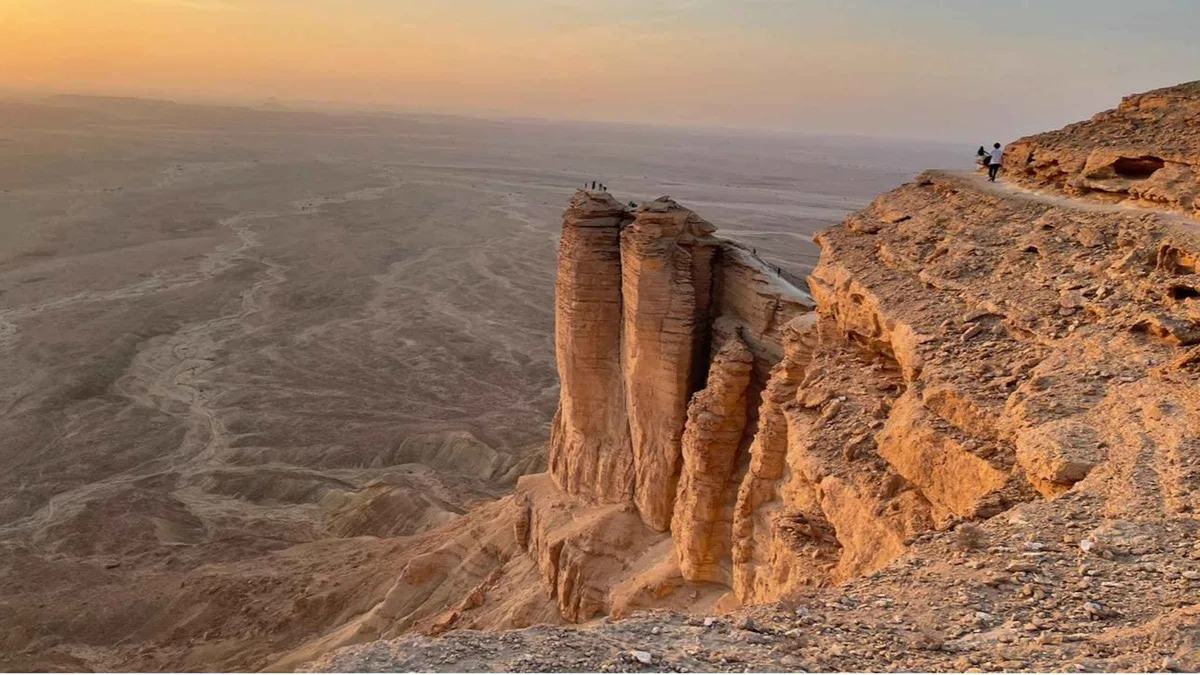
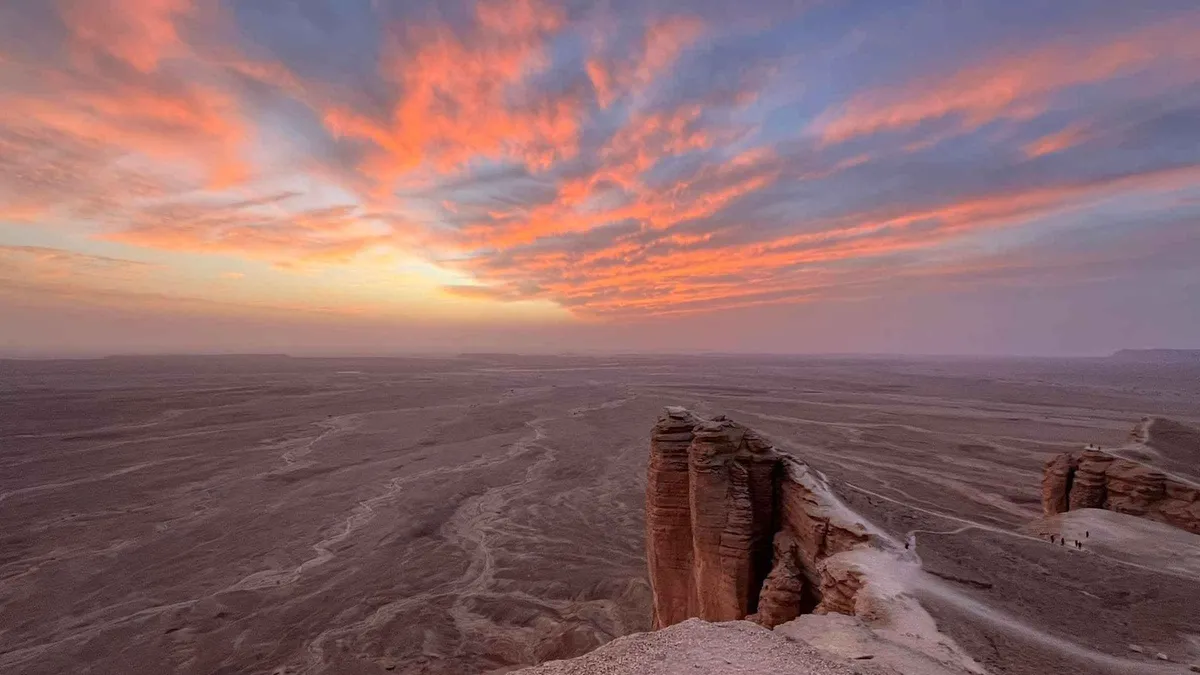
The unfenced limestone rim of Jebel Fihrayn dropping to the desert plain, the viewpoint reached on an Edge of the World Riyadh tour
There is no railing anywhere along the rim. The drop below this ledge is roughly 300 metres.

Where the Edge of the World Actually Is, and Why the Drive Decides Everything

The formation has a real name, a real elevation and a very specific access problem.

Ninety kilometres, two hours, and no bus

The Edge of the World is Jebel Fihrayn, a section of the Tuwaiq escarpment roughly 90 km north-west of Riyadh. Drivers count on about one hour forty to two hours each way, and the two figures are not a contradiction: the first half is highway, the second half is not.

There is no public transport to the site. No bus route, no shuttle, no taxi that will take the job on. The final stretch runs on unmarked, rocky desert track where the route is a matter of local knowledge rather than signage, and where a wrong turn puts you in an area with patchy phone signal. A standard rental saloon cannot make it, and coaches never attempt it. This is the single reason the guided-tour market for one free viewpoint is as large as it is.

Access to the wider area is managed through gates on the approach roads, and the site is treated as protected land rather than a developed, ticketed attraction. There is no visitor centre, no ticket window and no marked car park with a barrier — which is exactly why the operators handle the logistics and why the price of a seat is the price of getting there.

1,131 metres, or 300 — the number most listings get wrong

Tour copy quotes two heights and treats them as interchangeable. They are not. The clifftop at Jebel Fihrayn stands about 1,131 metres above sea level. The cliff face itself drops roughly 300 metres to the plain below. When a listing says you will stand on a 1,131-metre cliff, it means the elevation, not the fall.

The escarpment runs for hundreds of kilometres through central Saudi Arabia, and this is one accessible break in it where the wall turns and the plain arrives flat and unbroken to the horizon. Riyadh itself sits at about 612 metres, so the drive gains around 500 metres of elevation without ever feeling like a climb.

  • Riyadh city centre: about 612 m above sea level
  • Desert plain at the foot of the cliff: roughly 830 m
  • Clifftop viewpoint at Jebel Fihrayn: about 1,131 m
  • Height of the cliff face itself: roughly 300 m

The Drop, Drawn to Scale

Where the numbers sit against each other. The bar people mean when they say "the Edge of the World is 1,131 metres high" is the top one; the drop they picture is the gap between the last two.

  • Riyadh city centre 612 m Where the tour starts
  • Desert plain below the cliff 830 m The floor you are looking down at
  • Jebel Fihrayn clifftop 1131 m The viewpoint, about 300 m above the plain

Elevations rounded. The 300-metre figure is the cliff face; the 1,131-metre figure is height above sea level.

Tours vs Driving to the Edge of the World Yourself

Self-driving is legal and people do it. Whether it is sensible depends entirely on what you are driving and who is in the passenger seat.

What a do-it-yourself trip actually costs

A guided seat starts at $40. A rental 4x4 in Riyadh runs well above that per day before fuel, and the cars most agencies hand over on a tourist licence are two-wheel drive. Renting a genuine off-road vehicle, filling it and splitting it four ways lands close to the tour price, and you take on the navigation, the punctures and the recovery.

The honest case for driving yourself: you set your own hours, you can stay for the full blue hour after the tours have left, and you can sleep out there if you have the kit. The honest case against: the track is unmarked, the phone signal fails in places, there is no recovery service, and a puncture at dusk 40 km from the highway is a different kind of evening.

How you get thereCostTime at the cliffWatch out for
Guided group tour$40 to $70 per person1.5 to 4 hours, fixedMeeting points are rarely your hotel
Rented 4x4, self-drivenRental plus fuel, splitAs long as you wantUnmarked track, no recovery, no signal in places
Private car and driverQuoted per vehicleNegotiableAgree the waiting time before you leave the city
Standard rental carCheapest on paperNoneWill not reach the site; do not try

Who should book a tour without thinking about it

Anyone in Riyadh for a few days on business, anyone travelling with children, anyone without off-road driving experience, and anyone who wants to look at the view rather than the track. The drivers on these tours run the route several times a week and know which line through the last wadi is passable this month, which changes after rain.

The corollary: if you are an experienced desert driver with your own vehicle, recovery gear and a companion car, you do not need any of the six listings on this page. You need a location, a full tank and the sense to be off the track before full dark.

What a Sunset Trip Actually Looks Like, Hour by Hour

The shape below is drawn from the published itineraries of the compared listings. Departure times vary by operator; the proportions do not.

  1. 15:00 – 15:30

    Meeting point in Riyadh

    You find the guide at a café, a metro station or a fuel station forecourt. Vehicles leave close to on time because sunset does not wait.

  2. 15:30 – 16:30

    Highway north-west

    Tarmac, air conditioning, and a fuel-station stop where you buy water and use the last reliable toilet of the day.

  3. 16:30 – 17:15

    Camel farm or gazelle reserve

    Most operators break the drive with one stop. Ten minutes on the tighter itineraries, longer where the sanctuary visit is a selling point.

  4. 17:15 – 17:45

    Off the tarmac

    The last stretch is unmarked track. This is the section that shakes the vehicle and the part your driver is being paid for.

  5. 17:45 – 19:15

    On the rim

    Walking between viewpoints on uneven rock, photographs, and the sunset itself as the cliff face turns orange from the west.

  6. 19:15 – 20:15

    Tea, dinner or stargazing

    Depending on the listing: Arabic coffee at the vehicles, a camp dinner, or lights off for the stars once the sky is properly dark.

  7. 20:15 – 22:00

    Back to Riyadh

    Ninety minutes to two hours to the drop-off point, which on several listings is the same metro station you left from, not your hotel.

Sunrise, Sunset or Daytime

Nearly every listing sold from Riyadh is a sunset trip. That is not marketing habit — it is which way the rock faces.

Why sunset wins here

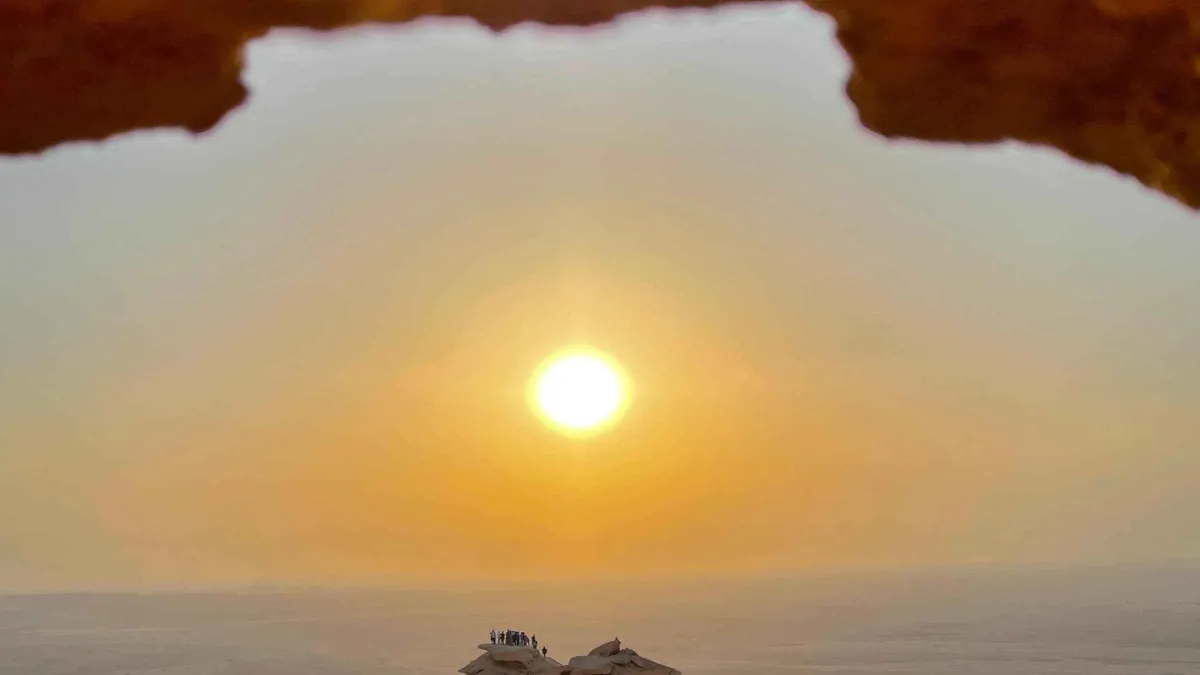
The escarpment looks out west and north over the plain, so the low evening sun strikes the cliff face straight on and the limestone goes deep orange in the last half hour. At sunrise the sun comes up behind the rim and the face you have driven two hours to photograph sits in its own shadow while the plain below lights up.

Sunset also unlocks the second half of the day. Once the sun is down and the camp lights are switched off, the desert sky at 90 km from the city is genuinely dark, and the tours that build in stargazing use that window. The trade-off is the drive home in the dark, arriving in Riyadh between 21:00 and 22:30.

A daytime visit is the worst of both: flat overhead light, no shade, and heat that from April onwards makes the walking unpleasant and from May dangerous. If a listing offers a midday departure in summer, that is a reason to look at a different listing.

The case for going at sunrise anyway

Two situations justify it. If you want the plain lit and the rim in silhouette — a different photograph, not a worse one — sunrise delivers it. And if you are visiting in the shoulder months of April or October, a sunrise start puts the walking into the coolest hours of the day and has you off the rock before the heat arrives.

Sunrise departures are thin on the ground on the booking platforms and usually run as private hires, which means quoting per vehicle rather than per seat. Expect to message an operator directly and expect a pickup around 03:30.

Best Time to Visit the Edge of the World

Bars show the average daytime high on the escarpment; the small figure under each month is the night-time low, which matters because the tours are out there after dark. The season, not the day of the week, is what decides whether this is a pleasant walk or a hazard.

  • Comfortable season (October–March)
  • Too hot to walk (May–September)

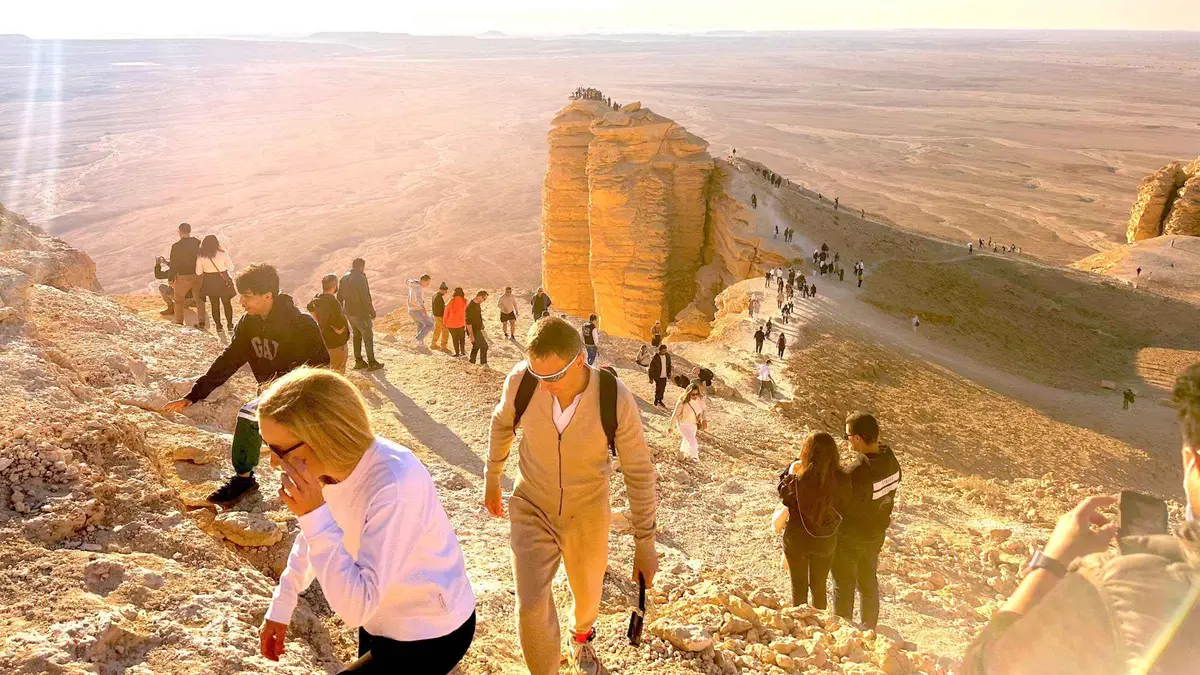
October to March is the window every guide agrees on: daytime roughly 18–25 °C (64–77 °F) at the cliff, nights near 8 °C (46 °F). From May to September the plateau passes 40 °C (104 °F) with no shade at any viewpoint. Weekdays are also markedly quieter than the Saudi weekend of Friday and Saturday, when Riyadh drives out in numbers.

No Fences, No Toilets, No Shade: What the Site Is Missing

The Edge of the World is not an attraction with facilities. It is a cliff in the desert, and everything you need arrives in the vehicle with you.

The unfenced edge

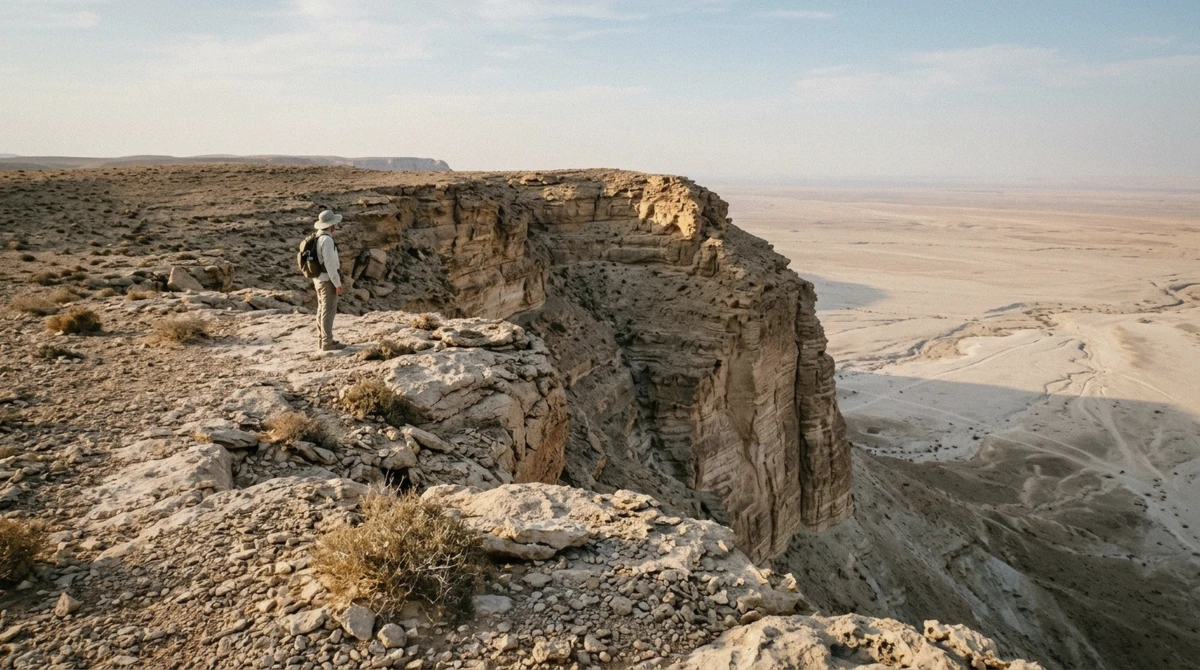
There are no railings, barriers or warning lines anywhere along the rim. The drop is sheer and the rock at the lip is loose in places. This is the point to take seriously if you are bringing children, if anyone in the group is unsteady on their feet, or if the wind is up — and it usually is, because the plain funnels it straight into the face of the escarpment.

Guides give a briefing and mark the sensible standing spots. Follow it. Every year brings stories of somebody backing towards the edge to fit more of the view into the frame.

  • No fences, railings or marked paths at the viewpoints
  • No toilets at the site; tours stop at a fuel station on the way out and back
  • No shade, no water, no shop, no bins — carry out everything you carry in
  • Phone signal drops in places on the desert approach
  • No entrance gate, no ticket office and no entry fee

Is it suitable for children and older travellers?

The walking is not hard — the distances between viewpoints are short — but the ground is uneven rock and the exposure is real. Several operators publish limits that tell you how they see it: two listings here are not sold to travellers over 70, one excludes pregnant travellers and people with back problems, and another excludes wheelchair users and anyone with a heart condition. None of the six is wheelchair accessible.

For children, the deciding factor is not the walk but the two-hour drive at each end, followed by an unfenced cliff at dusk. Families do this trip constantly and enjoy it; the ones who struggle are those who booked the longest itinerary with a small child and got back to Riyadh at 22:30.

The Add-Ons, Explained Honestly

Price differences between the listings come almost entirely from what is bolted onto the drive. Here is what each of those things actually is.

Camel farm and camel rides

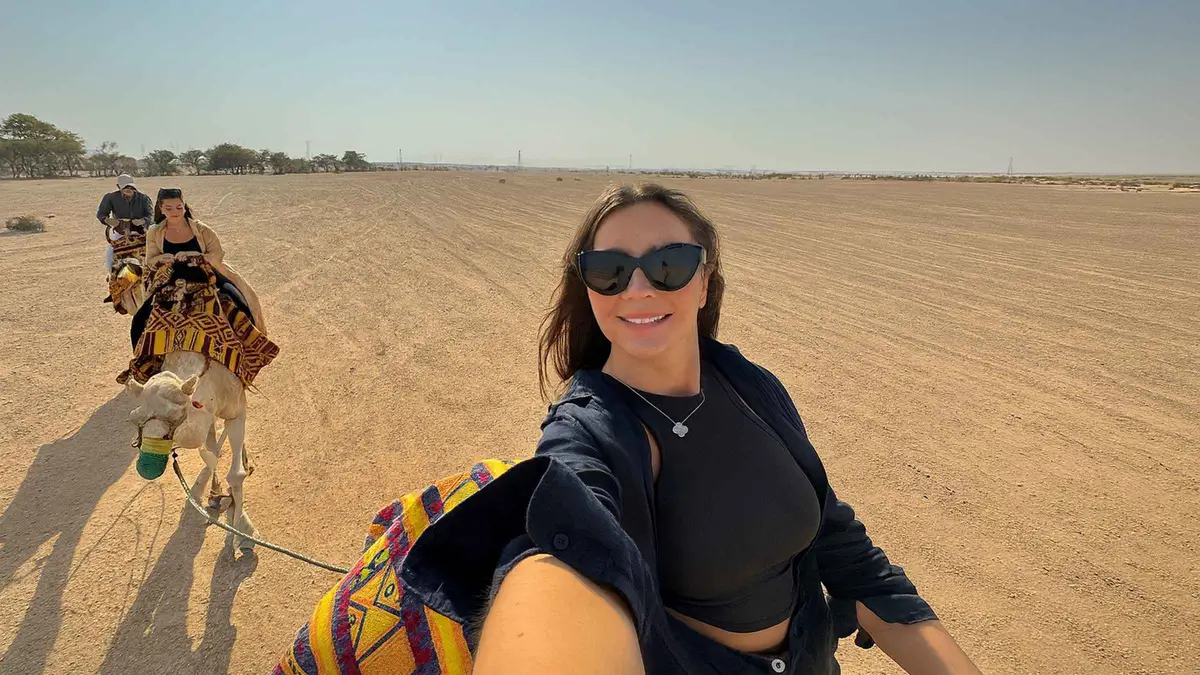
Two different things sold under one word. A camel farm stop, as on the cheapest sunset run, is a roadside working farm where the vehicle pulls over for ten minutes of photographs. A camel ride, as on the dinner trip, is a short circuit of seven to ten minutes on a saddled animal.

Neither is a trek. If riding an animal is not something you want to fund, the small-group sunset trip and the guided hike have no camel element at all.

The gazelle reserve

Three of the listings stop at a fenced reserve holding Arabian gazelles, described variously as a deer sanctuary, a gazelle park or a ghazal reserve — the same kind of place under different names. The animals are inside an enclosure, viewing lasts around ten minutes, and it is a break in a long drive rather than a wildlife experience. The Arabian gazelle is genuinely worth seeing; just calibrate what a ten-minute enclosed stop can be.

The bat cave

A cave in a neighbouring canyon with a resident bat colony, reached by a short scramble. The dinner listing puts an hour at it on the published itinerary and asks you to bring a flashlight, which is the honest signal: no lighting, no walkway, uneven floor. The guided hike listing carries the bat cave in its title while its published itinerary shows only the Edge of the World stop, so treat it as something to confirm with the operator through the platform's message thread before you book.

The Red Sand Dunes

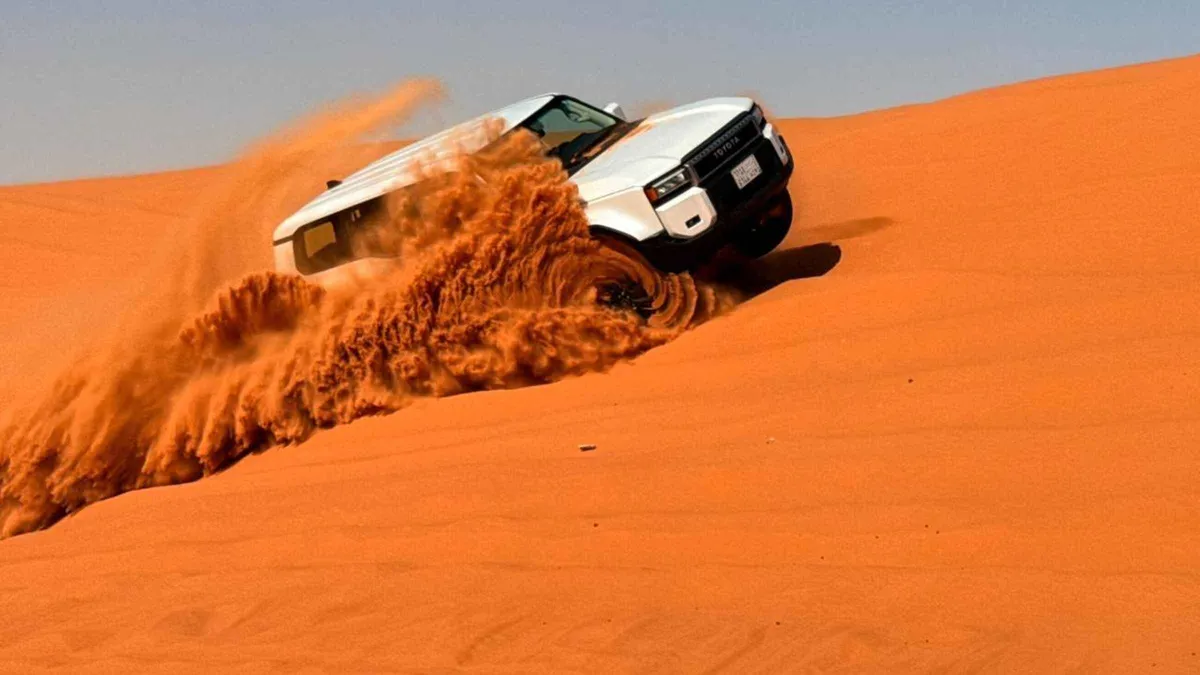
A dune field of iron-oxide-red sand roughly an hour north-east of Riyadh — the opposite direction from the escarpment, and a completely separate outing. The Red Sands safari is the activity version: half an hour of quad biking, half an hour of dune bashing, sandboarding and a short camel ride, with hotel pickup, over about four hours. At $156 from 31 reviews it is the most expensive listing here by a wide margin and it never approaches the cliff.

Book it as a second afternoon if you want engines and sand; do not book it expecting the view.

What to Wear and What to Bring

The packing list is short and every item on it is on it for a reason.

Clothing and footwear

Dress modestly, as everywhere in Saudi Arabia: loose clothing covering shoulders, upper arms and knees. Women are no longer required to wear an abaya or cover their hair, and visitors on these tours generally wear linen trousers and a long-sleeved top.

Shoes are the item people get wrong. The ground at the viewpoints is rough, uneven rock and the short climbs between them need grip — trainers or light hiking shoes, never sandals or flip-flops. Bring a layer for after sunset even in spring: the desert loses its heat fast once the sun is gone, and January nights at the cliff sit near 8 °C (46 °F) while the afternoon was 20 °C (68 °F).

  • Trainers or hiking shoes with grip — no sandals
  • Loose clothing covering shoulders and knees
  • A warm layer for after dark, October to March especially
  • High-SPF sunscreen, sunglasses and a hat: there is no shade at all
  • More water than you think, plus snacks if dinner is not included
  • A power bank — the cold and the camera drain a phone battery fast
  • A flashlight if your itinerary includes the cave
  • Cash for the fuel-station stop and for tipping the guide

Food, drink and the desert dinner

Saudi Arabia is a dry country. No alcohol is served at the desert camps, and the drinks on every one of these itineraries are bottled water, Arabic coffee, Saudi tea and soft drinks. Where dinner is included, it is usually kabsa — spiced rice with chicken or lamb — served at a camp or an istiraha.

Dietary requirements are the practical catch. Travellers have arrived with a vegetarian note on their booking and found chicken kabsa as the only option. If you do not eat meat, message the operator before the day and carry backup food regardless.

What an Edge of the World Tour Costs, and What the Money Buys

There is no ticket for this place. Everything you pay goes on getting there and on what somebody adds around the view.

The price range, and what moves it

Across the five cliff tours compared here, prices ran from $40 to $70 per person when the listings were read in August 2026. The Red Sands safari, which is a different destination, sits at $156. Private hires quoted per vehicle work out differently again: one group of six splitting a private tour reported about £53 each including dinner.

The spread between $40 and $70 does not buy a better view. It buys some combination of a newer vehicle, a smaller group, more hours on the rim, hotel pickup, or a meal. Ranked by what most people actually notice afterwards: hours on the rim first, vehicle comfort second, food third.

  • Site entry: free, and there is no gate to pay at
  • Group tours to the cliff: $40 to $70 per person
  • Dinner as a paid add-on where it is not included: around €35 on one listing
  • Red Sand Dunes activity safari: $156 with hotel pickup
  • Every listing here: free cancellation up to 24 hours, reserve now and pay later

What reviewers consistently flag

Across the six listings the review subscores published on the platform cluster tightly on guides — 4.6 to 4.9 — and spread more on transport, which runs from 4.4 to 4.9. That gap is the story of this trip. Guides here are repeatedly described as friendly, organised and good with a camera; the complaints attach to vehicles, air conditioning, crowded back rows and unclear pickup timing.

If a comfortable vehicle matters more to you than the last $15, the two listings scoring 4.8 and 4.9 on transport are the gazelle sanctuary trip and the small-group sunset run. If value is what you are optimising, the $40 listing with 1,154 reviews has held 4.7 across all three subscores at the lowest price on the page.

Edge of the World Riyadh Tours: Common Questions

Is the Edge of the World in Riyadh worth it?

For most visitors with a spare afternoon, yes — it is the one landscape near Riyadh that does not look like anywhere else, and the sunset on the cliff face is what people remember. Set expectations on two things: four hours of your day are spent driving, and the site has no facilities whatsoever. If you have one free afternoon and want a view rather than an activity, the $40 small-group sunset trip is the straightest route to it.

How do you get from Riyadh to the Edge of the World?

By 4x4, over about 90 km and roughly two hours, with the last stretch on unmarked desert track. There is no public transport, no shuttle and no taxi service to the site, and standard rental cars cannot reach it. That is why the compared tours exist. More on the route and the access gates is in the section on getting there.

Is there an entrance fee at the Edge of the World?

No. There is no ticket office, no gate fee and no booking requirement for the site itself. What you pay is transport: the vehicle, the driver who knows the track, and any food or add-ons the operator includes. Full price breakdown.

How long does an Edge of the World tour take?

Six to seven hours door to door for a standard sunset trip, of which about four are driving. The bat cave and dinner itinerary runs longer at seven to eight hours because it adds a cave visit and a sit-down meal. Time actually spent on the cliff ranges from 90 minutes to four hours — see the comparison table.

What is the best time of year to visit?

October to March, when daytime temperatures at the cliff sit around 18–25 °C (64–77 °F). From May to September the plateau passes 40 °C (104 °F) with no shade at any viewpoint, which turns the short walks between viewpoints into a real risk. Weekdays are quieter than Friday and Saturday. Month-by-month chart.

Should I book a sunrise or a sunset tour?

Sunset, in almost every case. The escarpment faces out over the plain, so evening light hits the cliff face directly while at sunrise the face sits in shadow. Sunset trips are also the ones that can add dinner and stargazing. The full comparison of light.

Is the Edge of the World safe to visit?

The drive is the managed risk and the cliff is the unmanaged one. There are no fences or railings anywhere along the rim, and the drop is roughly 300 metres. Stay back from the lip, follow the guide's briefing, and keep hold of children. Several operators exclude travellers over 70, pregnant travellers or people with heart or back problems — the restrictions are listed on each card above and in the safety section.

Do the tours pick you up at your hotel?

Mostly not. Most listings use a fixed meeting point — a metro station, a café, a fuel-station forecourt. The guided hike offers hotel pickup as a paid booking option, and the Red Sands safari includes it as standard, though that trip goes to the dunes rather than the cliff. Factor a taxi at each end into the real cost of the cheaper seats.

Can I drive to the Edge of the World myself?

With a genuine 4x4, off-road experience and recovery gear, yes — people do. With a rental saloon, no, and attempting it is how vehicles end up stranded. The track is unmarked, signal is patchy in places, and there is no recovery service. The self-drive comparison lays out the real costs.

What should I bring?

Shoes with grip, a warm layer for after dark, high-SPF sunscreen, a hat, sunglasses, more water than you expect to drink, a power bank and cash. Add a flashlight if your itinerary includes the bat cave. Full list.

Sunset slots on the higher-rated listings fill first in the cool season, and every one of them cancels free up to 24 hours ahead.

October to March is peak season for the cliff

Check Availability
Tours from $40 Check Availability